
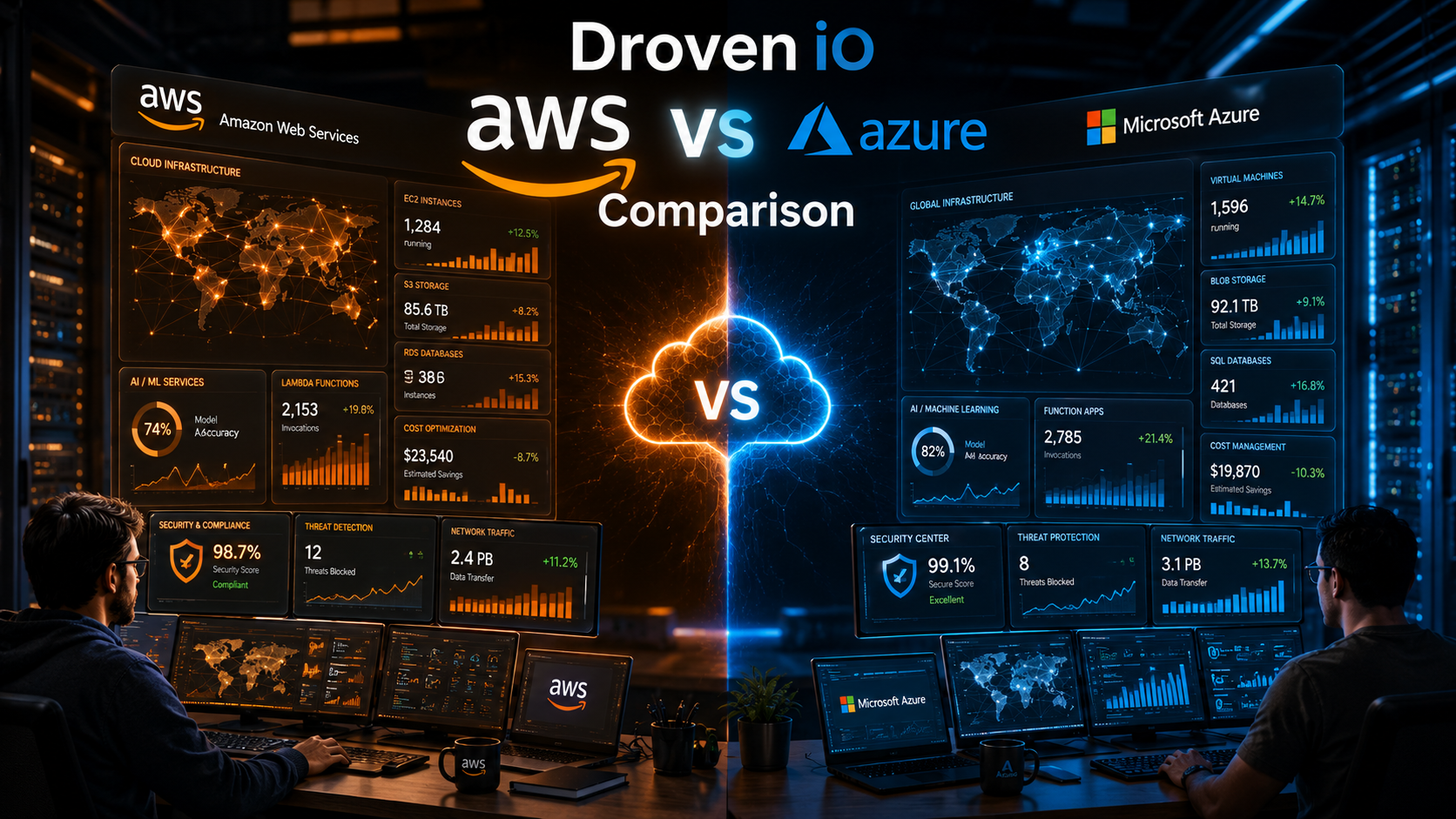
Picking the right cloud platform can feel overwhelming. You have dozens of features, pricing tiers, and marketing promises to sort through. That is why the droven io aws vs azure comparison has become one of the most searched topics among developers and IT teams this year. In this guide, we break it all down in plain language so you can make a smart, confident choice.
What Is Droven.io and Why Does It Matter?
Droven.io is a cloud management and optimization platform. It helps businesses monitor, compare, and control their cloud spending across multiple providers. Think of it as a dashboard that sits on top of your cloud setup and gives you a clear picture of what is working and what is costing too much.
When teams use the droven io aws vs azure comparison tools inside Droven.io, they get a side-by-side view of performance, cost, and usage. This saves hours of manual research and helps businesses avoid costly mistakes. It is especially useful for companies that use both AWS and Azure at the same time.
A Quick Overview: AWS vs Azure
Before we get into the Droven.io tools, let us quickly understand what each platform brings to the table.
Amazon Web Services (AWS) launched in 2006 and is still the largest cloud provider in the world. It offers over 200 services, from basic storage to machine learning tools. Many startups and large enterprises trust AWS for its reliability and global reach.
Microsoft Azure came a bit later, launching in 2010. It quickly became the go-to choice for companies already using Microsoft products like Windows Server, Active Directory, and Office 365. Azure now holds the second-largest share of the cloud market.
Both platforms are powerful. The right choice depends on your team, your budget, and your existing tools.
How Droven.io Simplifies the AWS vs Azure Decision
Running your own droven io aws vs azure comparison manually takes a long time. You have to check pricing pages, test performance in different regions, and track usage across multiple accounts. Droven.io does all of this automatically.
The platform pulls real data from both clouds and shows you cost breakdowns, performance scores, and service availability in one place. You can filter by region, workload type, or service category. This makes it much easier to decide where to run each part of your application.
Droven.io also alerts you when prices change or when one provider becomes a better deal than the other. That means you are not stuck with a decision you made six months ago. You can shift workloads when it makes sense.
AWS vs Azure: Core Features Side by Side
Here is a comparison table that reflects what you will typically find when running a droven io aws vs azure comparison report:
| Feature | AWS | Azure |
|---|---|---|
| Global Regions | 33 regions, 105 zones | 60+ regions worldwide |
| Compute Service | EC2 (Elastic Compute Cloud) | Azure Virtual Machines |
| Object Storage | Amazon S3 | Azure Blob Storage |
| Managed Kubernetes | Amazon EKS | Azure AKS |
| Serverless Computing | AWS Lambda | Azure Functions |
| Machine Learning | Amazon SageMaker | Azure Machine Learning |
| Hybrid Cloud | AWS Outposts | Azure Arc |
| Active Directory Support | AWS Directory Service | Native Azure AD |
| Free Tier | 12 months + always-free options | 12 months + always-free options |
| Pricing Model | Pay-as-you-go, Reserved, Spot | Pay-as-you-go, Reserved, Spot |
This table gives you a fast snapshot, but the details behind each row matter a lot. Let us dig in.
Pricing: Where Droven.io Adds Real Value
Pricing is often the number one concern for teams doing a droven io aws vs azure comparison. Both AWS and Azure use a pay-as-you-go model. You pay for what you use. But the actual rates vary depending on the service, region, and usage volume.AWS tends to have lower base prices for compute and storage in the US. Azure often offers better deals for Windows-based workloads because Microsoft owns the licensing. If your team already pays for Microsoft 365 or Windows Server licenses, Azure can give you significant savings through the Azure Hybrid Benefit program.
Droven.io shows you the exact cost difference based on your actual usage. It does not just show list prices. It accounts for reserved instance discounts, spot pricing, and enterprise agreements. This gives you a true apples-to-apples comparison.
Reserved Instances vs Savings Plans
Both platforms offer discounts if you commit to using resources for one or three years. AWS calls these Reserved Instances or Savings Plans. Azure calls them Reserved VM Instances. The savings can be 40 to 72 percent compared to on-demand pricing.
Droven.io tracks your commitment usage and tells you if you are getting the full value from your reservations. Many teams pay for reservations they do not fully use. The platform flags this waste so you can fix it fast.
Performance: AWS vs Azure in Real Workloads
Performance is not just about raw speed. It includes latency, uptime, and how well the platform handles traffic spikes. A droven io aws vs azure comparison on performance looks at all three factors.
AWS has a slight edge in raw compute performance for Linux workloads. Azure performs better for Windows-heavy environments because the integration is native and deep. For most web applications, the difference is small enough that it should not be the deciding factor.
Network Latency and Global Reach
AWS currently has more regions than Azure in parts of Asia and South America. If you serve users in those areas, AWS may deliver lower latency. Azure leads in Europe and has a strong presence in government cloud markets due to sovereign cloud options.
Droven.io lets you test latency from your specific locations. You enter your user base geography, and the platform estimates which provider will deliver faster load times. This is much more useful than guessing based on general marketing claims.
Security and Compliance: A Critical Part of the Comparison
Security matters no matter which platform you choose. Both AWS and Azure meet a long list of compliance certifications including SOC 2, ISO 27001, HIPAA, and FedRAMP. Choosing between them on security alone is difficult because both are genuinely strong. That said, Azure has an advantage for organizations inside the Microsoft ecosystem. Azure Active Directory ties directly into your user management. Role-based access control feels natural if your team already uses Microsoft tools.
AWS has a more modular security setup. Services like AWS IAM, GuardDuty, and Security Hub give you fine-grained control. But they require more configuration and expertise. Running a droven io aws vs azure comparison through Droven.io surfaces your current security gaps and shows you what each provider does to address them.
Compliance Automation
Droven.io includes a compliance module that checks your cloud setup against common security standards. It works across both AWS and Azure. If a setting falls outside your required compliance framework, the platform flags it and shows you how to fix it. This is a big time-saver for regulated industries like healthcare and finance.
Developer Experience: Which Platform Is Easier to Use?
Most developers find AWS harder to learn at first. It has so many services that the learning curve feels steep. Once you know it well, though, the depth of options is hard to beat. AWS has a massive community, and finding answers to almost any problem is easy.Azure is more approachable for developers who already work in the Microsoft world. Visual Studio integration, GitHub Actions support, and familiar Windows tools make Azure feel comfortable. For enterprise development teams, this can speed up adoption significantly.

Droven.io bridges this gap by giving both camps a common interface. Instead of learning two different dashboards and CLI tools, your team manages everything from one place. The droven io aws vs azure comparison view inside the platform uses simple language and clear charts, so even non-technical stakeholders can follow along.
Multi-Cloud Strategy: Using Both AWS and Azure Together
Many businesses do not have to pick just one. A multi-cloud strategy uses AWS for some workloads and Azure for others. You might run your data warehouse on AWS Redshift while hosting your Active Directory on Azure. It sounds complex, but Droven.io makes it manageable.The platform gives you a unified cost and performance view across both clouds. You set budget alerts, manage access, and review usage all in one place. Running a droven io aws vs azure comparison regularly helps you decide when to shift workloads between providers based on current pricing and performance data.
This approach also reduces vendor lock-in. If AWS raises prices or has an outage, you can move more workloads to Azure without starting from scratch.
Industry Use Cases: Who Uses What?
Different industries tend to lean toward one platform. Here is a general breakdown:
AWS is popular with:
- Tech startups and SaaS companies
- Media and entertainment businesses
- E-commerce platforms
- Research and data science teams
Azure is popular with:
- Enterprises using Microsoft 365 and Teams
- Healthcare organizations needing HIPAA compliance
- Government agencies requiring FedRAMP authorization
- Financial services firms with Windows-based infrastructure
No matter your industry, running a droven io aws vs azure comparison with your actual workload data gives you a clearer picture than any general recommendation can. Industry trends are a guide, not a rule.
The Final Verdict: AWS, Azure, or Both?
After running a thorough droven io aws vs azure comparison, most teams find that the answer is not black and white. AWS wins on sheer breadth of services and raw compute flexibility. Azure wins on enterprise integration, especially for Microsoft-heavy environments. Cost depends heavily on your workload mix.
Droven.io makes the comparison concrete instead of theoretical. It turns guesswork into data-driven decisions. Whether you are just starting out in the cloud or managing a complex multi-cloud setup, the platform gives you the visibility you need to stay in control.The goal is not to pick the “best” cloud. The goal is to pick the right cloud for your specific needs. And with tools like Droven.io powering your droven io aws vs azure comparison, you have everything you need to make that call with confidence.
Conclusion
Choosing between AWS and Azure is one of the biggest decisions your IT team will make. Both platforms are reliable, secure, and packed with services. The difference comes down to your team’s background, your existing software stack, and your budget.Running a droven io aws vs azure comparison through Droven.io removes the guesswork. You get real data, real cost projections, and real performance benchmarks based on your actual usage. That is far more valuable than generic comparisons or marketing brochures.
Start with a clear picture of your workloads. Use Droven.io to compare your options honestly. Then build a cloud strategy that fits your goals today and scales with you tomorrow.
FAQs About Droven IO AWS vs AZURE Comparison
What makes Droven.io different from manually comparing AWS and Azure on your own?
Manually comparing AWS and Azure means visiting separate pricing pages, reading different documentation, and trying to match up services that do not always have the same names. Droven.io pulls live data from both platforms and shows everything in one unified dashboard. It also factors in your actual usage patterns, reserved instance discounts, and regional pricing differences, which a manual comparison almost never captures accurately.
Can small businesses benefit from a droven io aws vs azure comparison, or is it only for large enterprises?
Small businesses actually benefit a great deal from running a droven io aws vs azure comparison because they have less room for error with their budgets. A startup paying for the wrong cloud setup can waste thousands of dollars before noticing the problem. Droven.io helps smaller teams make informed choices early, so they build on the right foundation from the start rather than migrating later at a higher cost.
Does it matter which cloud you start with if you plan to go multi-cloud later?
Your starting choice does shape your architecture, so it is worth thinking ahead. If you build everything tightly around AWS-specific services, moving parts of it to Azure later takes extra work. Starting with a cloud-neutral mindset and using tools like Droven.io from the beginning makes a multi-cloud strategy much smoother when the time comes.
How often should a team run a droven io aws vs azure comparison to stay current?
Cloud pricing and service offerings change frequently, sometimes several times a year. Running a droven io aws vs azure comparison at least once a quarter gives your team a current view of whether your current setup still makes financial and technical sense. Many teams set up automated monthly reports inside Droven.io so the data stays fresh without requiring manual effort.
What happens if the droven io aws vs azure comparison shows that switching providers would save money?
Seeing potential savings is useful, but switching providers is not always worth the migration cost and downtime risk. Droven.io helps you weigh the projected savings against the real cost of migration. In many cases, the smarter move is shifting only specific workloads rather than doing a full switch, and the platform helps you identify exactly which workloads make the most sense to move first.
